Building the Future of Football from the Margins: It’s Time for Regions to Become the Axis
By: Agus Sugeng Riyanto

For too long, football in Indonesia has been viewed from the center—from the glitz of big stadiums, established clubs, to the hustle and bustle of professional leagues. In fact, the real pulse of football life is in the regions: on simple fields, in local competitions that often escape the spotlight, and in young people who play with all their limitations but have big dreams.
From that anxiety, the Narrow Gaps initiative was born. Which is an alliance as a club that was officially ratified at the PSSI Central Java congress in 2025 as a member club that is ready to compete in League 4 and Suratin.
A movement that tries to close the gap between potential and opportunity, between talent and a coaching system that has not yet been fully developed.

The main problem with regional football is not actually a lack of talent. Indonesia is rich in talented young players. However, what is often absent is a system capable of directing them. Many players stop improving not because they can’t, but because they don’t have a clear path. The lack of facilities, limited quality coaches, and the absence of sustainable competition mean that potential just stops being potential.
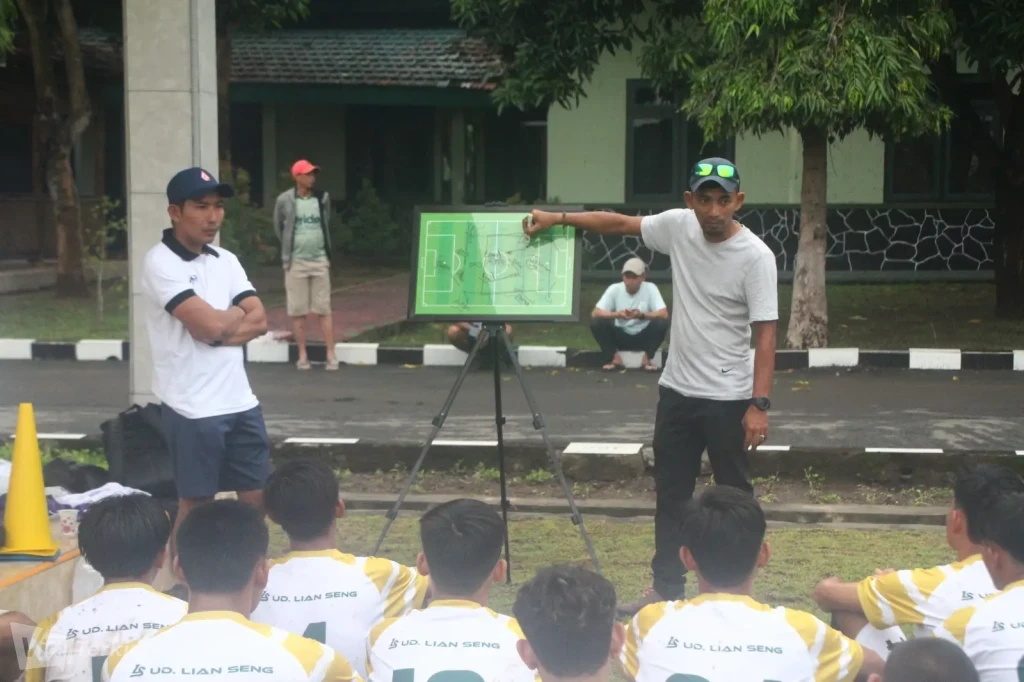
At this point, early childhood competition becomes a non-negotiable foundation. The U-16 League which was initiated in Tegal Regency is not just a competition event, but an effort to build an ecosystem. Competitions that run in a full league format give young players something they have been missing: playing time and consistency. Without regular competition experience, it is impossible to form players who are ready to move up to a higher level, including to a level like Elite Pro Academy Liga 1.
However, modern football demands more than just competition. The data-based approach implemented through the Talent ID system is a progressive step. Talent identification no longer relies solely on intuition, but is strengthened by statistical analysis and player development mapping. This is an important leap towards more objective and sustainable coaching.
Interestingly, this approach also touches economic aspects. So far, regional football has often been seen as a burden on the budget. In fact, if managed with the right vision, it can become a productive ecosystem. From coaching, data analysis, sports equipment production, to other supporting sectors, football can open up new jobs and stimulate the local economy.
Efforts to build financial independence through collaboration with the industrial and agro sectors are also a strategic step. This is important to break dependence on the government, while ensuring program sustainability. However, one thing that should not be overlooked is consistency. Many regional football initiatives were born with great enthusiasm, but faded midway due to a lack of long-term commitment.
Therefore, collaboration is key. Local governments, the private sector, communities and the media must work together. In the digital era, exposure opportunities are wide open. Live broadcasting of competitions via digital platforms not only expands reach, but also invites people to become part of this movement—not just spectators, but supporters of the ecosystem.
In the end, building regional football is not an instant job. It requires vision, patience and courage to start small. But it is precisely from these small fields that the future of Indonesian football should be built.
If we want real change, then the direction of view must be reversed: from the regions to the center. Because, that’s where the real foundation lies. (***)
Author Biodata:
Name: Agus Sugeng Riyanto
Origin: Tegal Regency, Central Java
Profession: National Football Coach (A Pro License)
Role: Founder of Narrow Gaps
Focus: Youth football development, data-based coaching, and building a sustainable regional football ecosystem
Vision: Encourage the birth of professional players from the region through a coaching system that is structured, competitive and financially independent
PakarPBN
A Private Blog Network (PBN) is a collection of websites that are controlled by a single individual or organization and used primarily to build backlinks to a “money site” in order to influence its ranking in search engines such as Google. The core idea behind a PBN is based on the importance of backlinks in Google’s ranking algorithm. Since Google views backlinks as signals of authority and trust, some website owners attempt to artificially create these signals through a controlled network of sites.
In a typical PBN setup, the owner acquires expired or aged domains that already have existing authority, backlinks, and history. These domains are rebuilt with new content and hosted separately, often using different IP addresses, hosting providers, themes, and ownership details to make them appear unrelated. Within the content published on these sites, links are strategically placed that point to the main website the owner wants to rank higher. By doing this, the owner attempts to pass link equity (also known as “link juice”) from the PBN sites to the target website.
The purpose of a PBN is to give the impression that the target website is naturally earning links from multiple independent sources. If done effectively, this can temporarily improve keyword rankings, increase organic visibility, and drive more traffic from search results.
Comments are closed, but trackbacks and pingbacks are open.