Viralterkini.idJAKARTA — The book “Balinese Colors: When Systems & Meetings Become Identity” was officially launched on Thursday, April 16 2026 at Bentara Budaya Jakarta.
This launch is a collaboration between Kompas Daily and the Satya Djaya Raya Foundation (YSDR), as an effort to enrich public understanding of Indonesian culture, especially Bali, amidst the challenges of globalization.
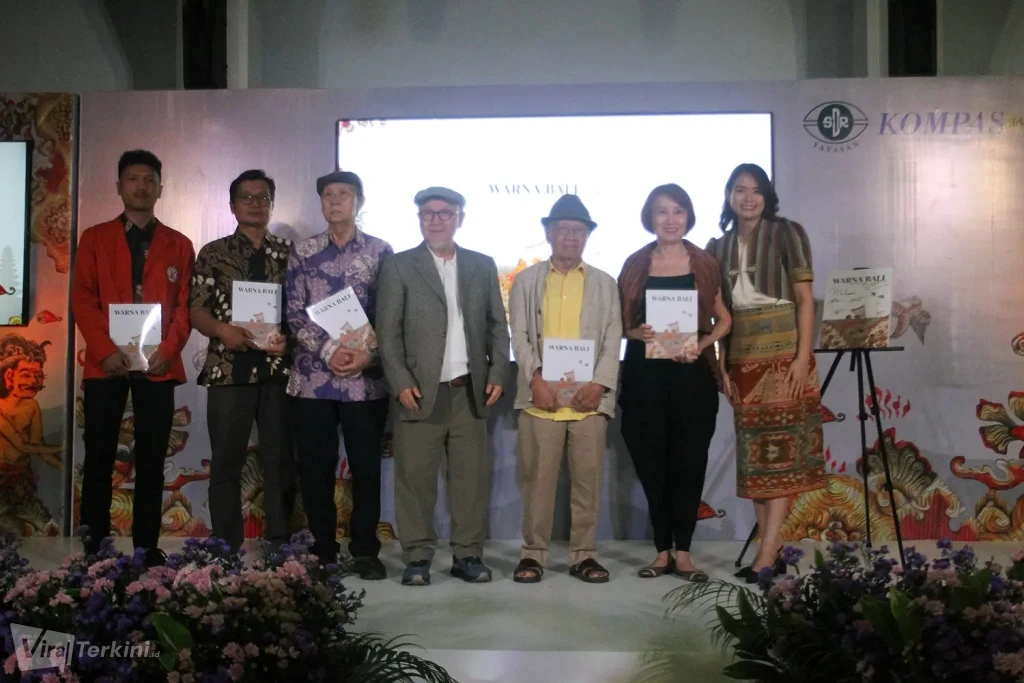
This book explores color as not just a visual element, but as part of a living system of meaning in Balinese culture. Through approaches to cosmology, spirituality, and the history of cultural encounters, this work offers a comprehensive perspective in reading Balinese identity as the result of a long process of acculturation.
In his speech, Deputy Chief Editor of Kompas, Adi Prinantyo, emphasized that this book was presented to open a space for public reflection.

“This book invites us to see color not only as something visible, but as an entry point to understanding the value systems, history and perspectives that shape culture,” he said.
The launch event was also attended by YSDR representatives, namely Osbert Lyman and Tomi Pratomo, and continued with a book review session with a number of academics and cultural practitioners.
The discussion presented the Head of the Kompas Culture Desk, Mohammad Hilmi Faiq, academic I Wayan Seriyoga Parta, humanist Putu Fajar Arcana, and fine arts teacher Mikke Susanto.
In the discussion, Hilmi highlighted the role of media in bridging cultural knowledge to the wider public. He considers this book important because it places color as a link between humans, nature and the Creator, so that its delivery must maintain the depth of philosophical meaning.
Meanwhile, I Wayan Seriyoga Parta explained that colors in Balinese culture cannot be separated from cosmological systems such as Pangider Bhuwana, Nawa Sanga, and Pancawarna. He emphasized that the use of color in traditional arts, such as wayang Kamasan, has rules and symbolic meanings that have been passed down from generation to generation by the sangging people.
A similar view was conveyed by Putu Fajar Arcana who considered that color in Balinese art is sacred and is a spiritual medium that connects humans with the Creator. According to him, every color in Balinese art contains a cultural narrative that can be read and interpreted.
From a fine arts perspective, Mikke Susanto considers that color in the Balinese tradition is part of a symbol system that continues to develop. He emphasized that even though Balinese art is now also present in a contemporary context, the sacred meaning of color remains relevant and an important foundation.
The discussion was interactive and related the contents of the book to the current context, especially in the face of globalization which has the potential to reduce the symbolic meaning of culture to mere visual aesthetics.
In another presentation, it was stated that Bali is not a single cultural entity, but rather the result of a mixture of various influences such as Indian, Chinese, Arab and Western which combine harmoniously. Color in this context becomes a medium for interaction and adaptation to foreign cultures which then undergoes transformation in the local context.
This book is also positioned as not just a collection of writings, but rather a reflection to understand identity and cultural origins, especially for the younger generation. Kompas Book Publishers assesses this work as part of efforts to increase cultural literacy in Indonesia.
One of the speakers also shared personal reflections regarding his interest in Balinese art, which started from direct experience to studying Chinese painting in Taiwan. He highlighted the similarities in philosophy between Chinese and Balinese art, especially in terms of balance, harmony, and the ability to absorb external influences without losing identity.
Through the launch of this book, the public is invited to see color not only as an aesthetic element, but as a knowledge system that records historical journeys, cultural encounters, and the values that shape identity. This activity also emphasizes the importance of understanding culture as a whole as a foundation in facing changing times. (ma)
PakarPBN
A Private Blog Network (PBN) is a collection of websites that are controlled by a single individual or organization and used primarily to build backlinks to a “money site” in order to influence its ranking in search engines such as Google. The core idea behind a PBN is based on the importance of backlinks in Google’s ranking algorithm. Since Google views backlinks as signals of authority and trust, some website owners attempt to artificially create these signals through a controlled network of sites.
In a typical PBN setup, the owner acquires expired or aged domains that already have existing authority, backlinks, and history. These domains are rebuilt with new content and hosted separately, often using different IP addresses, hosting providers, themes, and ownership details to make them appear unrelated. Within the content published on these sites, links are strategically placed that point to the main website the owner wants to rank higher. By doing this, the owner attempts to pass link equity (also known as “link juice”) from the PBN sites to the target website.
The purpose of a PBN is to give the impression that the target website is naturally earning links from multiple independent sources. If done effectively, this can temporarily improve keyword rankings, increase organic visibility, and drive more traffic from search results.
Comments are closed, but trackbacks and pingbacks are open.